- All
- Product Name
- Product Keyword
- Product Model
- Product Summary
- Product Description
- Multi Field Search

Views: 2 Author: Site Editor Publish Time: 2026-09-17 Origin: Site
1. Product Introduction
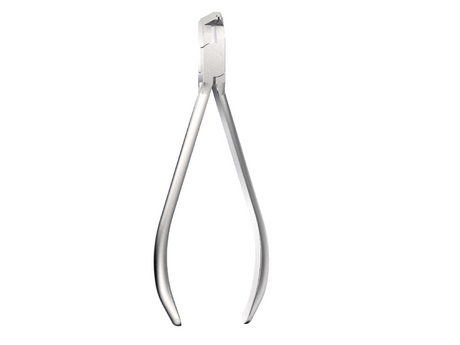
The fine wire cutter, also named Light wire cutter, is a precision special instrument for orthodontic treatment. Manufactured from medical-grade stainless steel, it features high-hardness cutter head and ultra-sharp cutting edges. It is available in three models: Light wire cutter 0° (0° straight head), Light wire cutter 13° (13° angled head) and Light wire cutter 45° (45° angled head). The 0° straight head is suitable for wire cutting in the anterior dental area with intuitive operation and unobstructed vision. The 13° angled head is more applicable for conventional deep operation in the posterior oral cavity. The 45° angled head is designed with a larger inclination angle, perfectly adapting to narrow, deep and visually restricted posterior oral areas. This instrument is mainly used for precise cutting of orthodontic ligature wires and fine elastic wires in clinical practice.
2. Scope of Application
Light wire cutter 0°, Light wire cutter 13° and Light wire cutter 45° are only applicable for cutting orthodontic fine wires with a diameter of ≤0.012 inches (0.3 mm), including soft fine materials such as ligature wires and fine elastic wires.
Prohibited from cutting over-sized materials such as thick arch wires, main arch wires and hard steel wires, so as to avoid cracking, deformation and blunting of cutting edges, which may cause instrument damage and potential clinical safety hazards.
3. Standard Operating Procedures
1. Pre-operation Inspection: Check the integrity of the cutter before use. Ensure the hinge is free of looseness and jamming, and the cutting edges are tightly closed without notches or rust to guarantee accurate and smooth cutting. The inspection standard applies to Light wire cutter 0°, Light wire cutter 13° and Light wire cutter 45°.
Standard Operation: Place the fine wire to be cut accurately at the center of the cutter tip edge. Hold the handle stably and apply force evenly to cut the wire at one time, ensuring a smooth and burr-free incision. The Light wire cutter 0° (0° straight head) is designed for flat and intuitive cutting operations in the anterior dental area. The Light wire cutter 13° (13° angled head) adopts an angled design to avoid visual obstruction, perfectly adapting to fine wire cutting in conventional deep and narrow posterior oral cavity areas. The Light wire cutter 45° (45° angled head) features a larger angled structure, which effectively avoids visual barriers and is suitable for fine wire cutting in deeper, narrower and visually blind posterior oral areas.
Safe Operation: Light wire cutter 0°, Light wire cutter 13° and Light wire cutter 45° are not equipped with a wire-locking groove, and the cut fine wire end may bounce off. Cutting outside the oral cavity is preferred. If intraoral operation is necessary, effective protection of soft tissues must be taken to prevent mucosal scratches, wire inhalation and accidental swallowing.
4. Prohibited Matters
1. Do not cut overloaded thick wires, hard wires or foreign metal objects, and do not use the instrument for prying or pressing violently.
2. Do not mix the use of fine wire cutters with distal end cutters. Each instrument shall be used for its dedicated purpose to extend the service life and ensure operating accuracy.
3. Do not disinfect with open fire at high temperature, and avoid violent collision and dropping to prevent edge damage and cutter body deformation.
5. Cleaning, Disinfection and Maintenance
1. Post-operation Cleaning: Clean up residual stains and metal debris on the cutter tip immediately after use. Clean the instrument with the hinge open to avoid dirt residue in gaps. This cleaning requirement is applicable to Light wire cutter 0°, Light wire cutter 13° and Light wire cutter 45°.
2. Disinfection Specifications: Adopt high-pressure steam sterilization with the temperature strictly controlled within 140℃. Excessively high temperature and prolonged sterilization are prohibited. Ensure the instrument is completely dry before storage after disinfection.
3. Daily Maintenance: Regularly apply special orthodontic maintenance white oil to the hinges and movable joints to prevent jamming and rusting. For long-term storage, place the cleaned and dried instrument in a ventilated and non-corrosive environment.
4.Regular Inspection: Check the sharpness of cutting edges and closing accuracy daily. Stop using and replace the instrument immediately if edge blunting, chipping or hinge looseness occurs.